I spent this weekend in San Diego, attending a seminar with Steve Ubl and HDKI’s Scott Langly. The event drew about 45 people from all over the world, many of whom I hadn’t seen for a few years, so it was a great excuse to see old friends, make new ones, and learn a thing or two along the way. After about a dozen hours of training, and innumerable after-class conversations, here are my major takeaways:
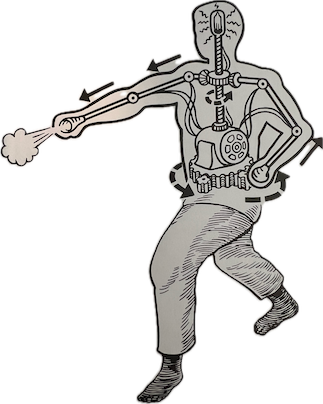
Maximum power from hip rotation is generally achived by holding the front hip in place (like the hinge of a door) and rotating the rear hip forward (like slamming the door). Thus, all of the mass that’s moving is moving forward. But there’s a famous picture in Volume 2 of Nakayama’s “Best Karate” series (below) that makes it look like hip rotation is accomplished by rotating both hips, in opposite directions.
I’d been working with the “stable front hip” method so long that I’d come to view this picture, not as “wrong” but rather “oversimplified.” But on further reflection, the method shown here, while suboptimal from the perspective of power generation, does have advantages in terms of speed and how quickly you can engage the front leg to become a driving leg while stepping forward. In kata, we see this in Heian Nidan, when we counter-rotate the hips while blocking before driving forward with a front kick.
In free-sparring, you’re typically always going to want to have your “shields up”, with at least one hand between you and your attacker, ready to block, grab, etc. But modern kata practice seems to have dropped this “best practice” in many places. Two examples came up over the weekend. One, in Tekki Shodan, appears on move #7, as you step across to the left to execute an uchi uke. Most people keep the left hand on the hip through the entire block, but extending the hand forward makes sense assuming the attacker is in front of you. Another, in Hangetsu happens on move #11 as you turn into the first kiai. You’re rotating 180° counterclockwise and executing a double block, presumably because there’s someone there. But if there’s someone there, you wouldn’t want to cross both arms in front of your body (as you see so many people do) for this turn. Instead, you’d want to turn and cover with the right hand, bringing it to exactly the right place to execute it’s half of the double block as you settle into stance. TL;DR: Keep your “shields” up.
Kata Chinte apparently has an alternate ending (in place of the hops) as seen here, along with an explanation of its provenance through Nakayama Sensei. I encourage you to watch the video from 43:11 through at least the 48-minute mark. As he says later in the video, this isn’t meant as a replacement, but perhaps as an additional method of practice for those of us who just can’t wrap our heads around the “three hops” ending.
Yoko-geri keage should have no femoral pronation during the extension phase. Yes, the hip lifts. Yes, the leg snaps out and back at the knee. But no … the femur should not rotate outward during that extension. I’ve always had trouble with this kick, but getting “heel higher than toe” was always a priority and one way to do that is to pronate the femur. But it turns out this can be bad for your hips. To be clear, this does not simply turn it into a “front kick executed to the side” as the SKA does. There’s still a lateral pelvic tilt and you’re still making contact with the edge of the foot. The only change is the elimination of the “hackey sack” like rotation of the hip during the extention phase. I’ve already had one hip replaced, and I’m probably looking at having the other replaced in the next 3-5 years, so anything I can do to reduce unnecessary stress on my hips is a welcome change.
Finally, I recieved a compliment from another attendee that I really want to share. At dinner after the second day of classes, someone said, “I’ll bet you’re a really good teacher.” I thanked her but, since she’d never seen me teach, asked why she thought that. She said, “Everyone else is asking questions about how to do things, but all of your questions are about how to teach things.” On reflection, I suppose that’s probably true. My contributions to the art are mainly through teaching now.