2024-07-31
Teaching my regular classes at the Ross Farnsworth - East Valley YMCA.
Though it’s fallen out of favor in some circles, I still give “pre-arranged” or “promise” sparring (yakusoku kumite) a place in my curriculum as an important bridge between kihon and jiyu kumite. Tonight, I introduced the adult class to attacking, and defending agaist, yoko-geri kekomi as part of yakusoku ippon kumite.
The attacker, starting from left-side zen-kutsu dachi steps forward with the rear leg and executes a chudan level yoko-geri kekomi towards the defender. The devenders are welcome to block and counter however they like eventually but, since we have to start somewhere, I have them start by pivoting backward on the left leg and blocking the kick to the inside using gedan kake-uke (seen below against a front kick).
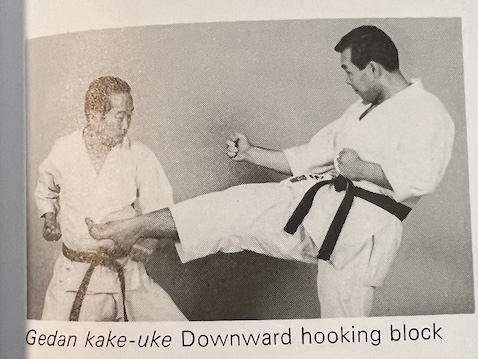
The combination of the pivoting hip and the sweeping arm will tend to guide the kick past the defender, possibly unbalancing the attacker, with the attacker landing beside the defender. If this is done well, the attacker’s back will be partially or fully exposed to the defender’s counterattack.
Unfortunately, even with the back exposed, I find that most defenders struggle to counterattack from this position, often resulting in an ineffective punch to the attacker’s bicep or elbow, and often with the hips overrotated to the point of instability. To fix this, we work on two things:
- Proper hip alignment: After rotating clockwise with right foot to block, it’s often necessary to rotate the front foot counterclockwise during the counterattack to achieve proper stance width and support hip rotation.
- Thoughtful target selection: The attacker’s right arm is often in the way of a good reverse punch to the ribs, so we need to be prepared to attack other things. A reverse punch to the head, knife-hand or ridge-hand to the throat or bridge of the nose, or even a left-handed backfist to the nose are good options from this position.