2026-07-13
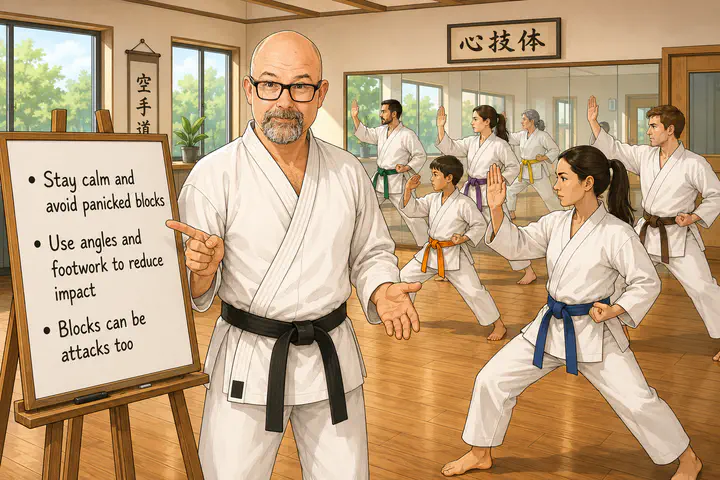
Teaching my regular classes at the Ross Farnsworth - East Valley YMCA.
Blocking is strange. On the one hand, we rarely use our traditional “blocks” in kumite. On the other hand, our traditional “blocks” work great as attacks, whether that’s attacking the limb being used to attack us, or attacking the attacker as we do at the end of Heian Nidan. Perhaps that’s why, when we do use them to block attacks, we tend to bruise our training partners.
Some of it is almost certainly a panicked fear response - we don’t want to get kicked, so we smash our forearm down on the attacking shin. But learning how to remain calm and avoid panicking is part of training, so that excuse only goes so far.
Some of it is unquestionably skill related. Most injuries in class happen when one side throws an attack and the other side “ran right into it” with their face. Blocking injuries are similar - one side throws and attack and the other side “runs right into it” (albeit intentionally) with their block. It’s a failure to judge distance to a rapidly approaching target.
But some of it is due to a poor understanding of physics and bad footwork. If you intercept an incoming attack at 90°, someone is going to get bruised. Block at 45° and that’s less likely to happen. The smaller the angle, the smaller the impact. Then add footwork - if you get off the line of attack you hardly have to block at all.
Put all of this together and karate blocks become just another flexible tool in our toolbox. If you want to not get hit, get out of the way and guide the attack past with a “block” that’s more like a matador avoiding a bull charge. If you want to destroy the incoming limb, meet the attack head on. Either way, we need to practice our blocks with the same degree of seriousness that we use when practicing attacks because, if you do them well, that’s what they are.