2026-07-20
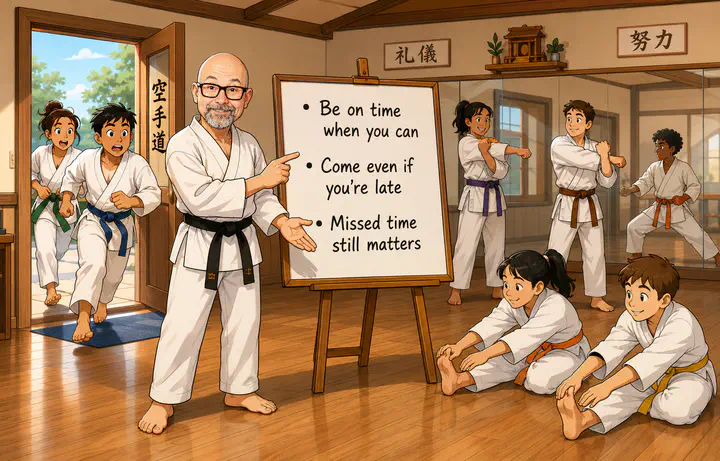
Teaching my regular classes at the Ross Farnsworth - East Valley YMCA.
I have a love/hate relationship with punctuality in my karate classes. I hate when students are late, but I love having students.
Obviously, I prefer that everyone be in class, dressed, and ready to go on time. In reality, people have to work late. Traffic, kids, and life sometimes get in the way. I would always rather have a student arrive late than not come at all. At the same time, my students understand that missed practice leads to poorer performance. Most of them have heard me say the following:
“It’s not my job to judge the reason for your absence, but it is my job to judge the consequences.”
If someone is habitually late, we have a conversation. If they can’t make it to class on time, okay - I get it - but we agree that it probably will have an effect on their performance. With kids, it’s harder because they’re not driving themselves. If their parents pull into the parking lot late and drop them off in their street clothes, the kids never had a chance to be on time.
Still, until I know someone can’t be on time, I call it out when I see it. “You’re late … try to be here a few minutes earlier next time!” Ordinarily there’s no reply beyond an embarrassed nod, and there doesn’t need to be. I don’t need a defense, and I don’t want students to feel that they have to prove their circumstances were sufficiently awful to earn permission to train.
The missed time still matters. If you miss the warmup, you missed the warmup. If you arrive after I explain a drill, someone has to catch you up. A good reason can explain those consequences, but it can’t erase them.
What the student does next matters too. Someone who comes through the door twenty minutes late, changes quickly, and gets to work has made a better decision than someone who decides that being late is the same as not coming. They can’t recover the first twenty minutes, but they can make good use of everything that remains.
So the standard isn’t simply “never be late.” Be on time when you can. When you can’t, come anyway. And when you arrive, get to work.