2026-07-22
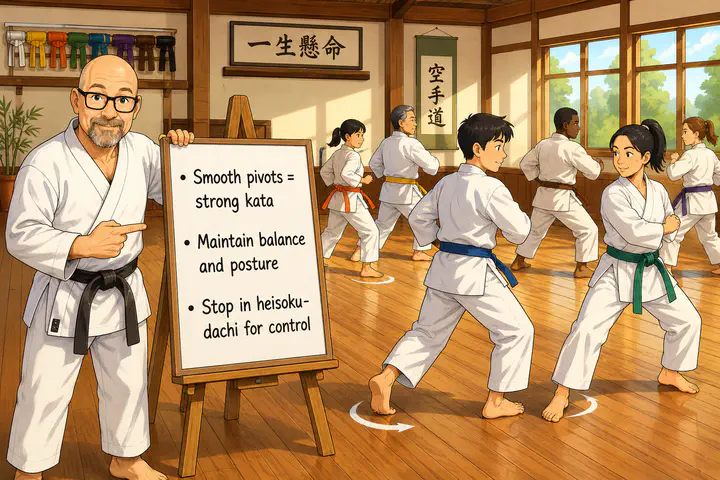
Teaching my regular classes at the Ross Farnsworth - East Valley YMCA.
Everyone likes to work on punches, kicks, and blocks, but pivots are the foundational building blocks of kata, and I don’t think we spend enough time working on them. That’s why I like to isolate them and practice them on their own. If you can pivot smoothly, maintaining balance, posture, and control, you can “stack” whatever techniques you want on top and still have good kata. But the reverse is not true. You cannot put perfect punches and blocks on top of a 💩 stance and end up with anything better than garbage.
Here are the drills I use to isolate and train pivots. All of them involve starting in a front stance and then bringing your back foot together with your front foot while pivoting. Throughout each drill, the front foot remains the pivot point:
- Start in front stance, left foot forward. Then, pivot 90° to the right while bringing your back foot together with your front foot. To be clear, the left foot simply pivots 90° to the right and the back foot comes up to meet it in heisoku-dachi.
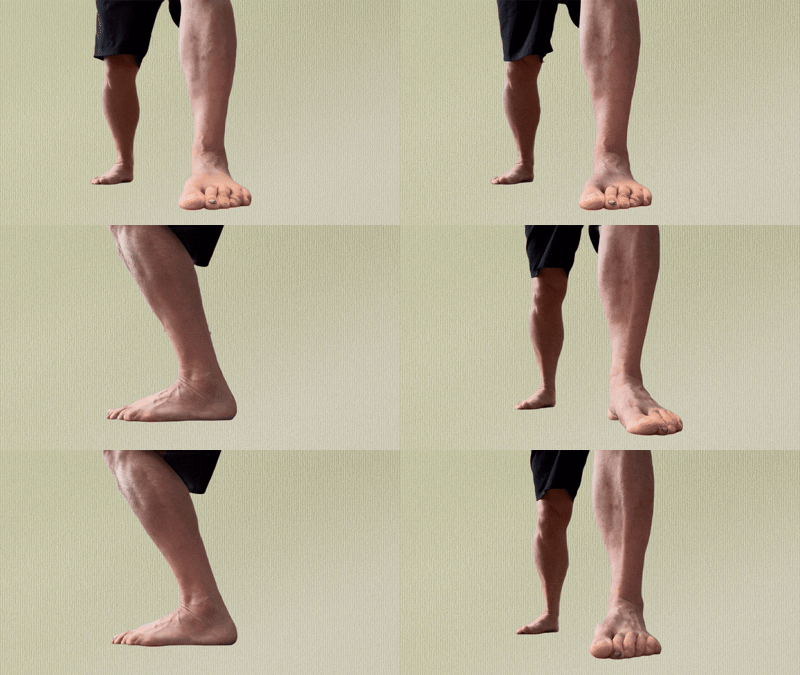
- Repeat the drill with a 180° pivot, keeping the left foot as the pivot point.
- Repeat it again with a 270° pivot, still keeping the left foot as the pivot point.
The longer the pivot, the harder it gets, and these are the problems that generally come up:
- Shifting the axis of rotation - Many people start to pivot on the heel, lose balance, and shift their weight to the ball of their foot halfway through the pivot, or vice versa. A smooth pivot requires a single axis of rotation. Pick one and stick to it.
- Poor posture - Students often lean forward, which shifts their center of gravity forward, and then they stick out their butt to compensate. Adding rotation makes that misalignment even harder to control.
- The need to step - Almost everyone trying these drills, especially the 270°, feels the need to step forward instead of stopping with the feet together. Why? Because heisoku-dachi provides a very small base and it’s easy to lose your balance. Stepping forward into front stance is comfortable, but if the goal is a smooth, balanced pivot, then we need to practice in “hard mode” - stopping at the halfway point without stepping forward.
That stopping point is the test. Hold heisoku-dachi until you have complete control of your balance and posture; only then should you add the next stance or technique.