2026-08-03
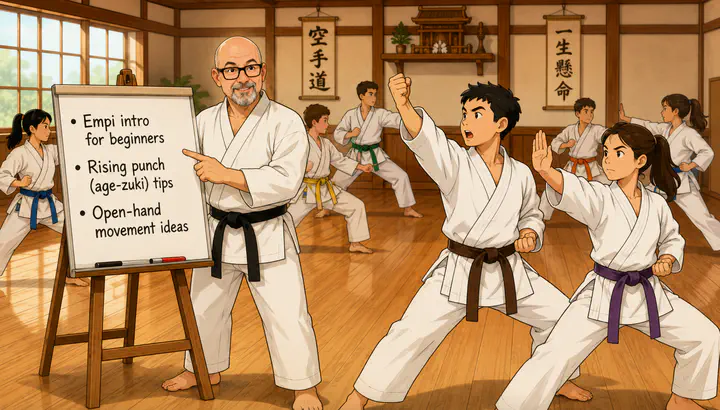
Teaching my regular classes at the Ross Farnsworth - East Valley YMCA.
I’ve been teaching Empi to everyone in my adult class. It’s beyond what most of the lower-ranked students are expected to know, so I’m not looking for proficiency yet. I want the kata to feel familiar when it eventually appears on their syllabus. Two parts of the kata consistently need explanation: the age-zuki and the open-hand movement that follows it.
Age-zuki
The “rising punch” is Shotokan’s version of the uppercut. A boxing-style uppercut is fine, but it requires you to be much closer to the target, and the more you extend your arm, the more likely you are to make contact with the fingers instead of the knuckles. Absent boxing gloves, hitting with the fingers is likely to break them. To fix that, we just flip the hand over and make contact with the top edge (uraken) of the same two knuckles we ordinarily use for a straight punch. The main problems I see are turning this into a straight punch to the face or launching the punch downward and then rising up. Instead, it should begin exactly like a straight punch to the body, but then start to arc upward at the same time it begins to flip over.
The “open hand” thing right after the age-zuki
What comes after the rising punch is performed and interpreted differently across Shotokan lineages, but here’s what I think: Saying that the opening of the hand is a precursor to grabbing the attacker and pulling them into the knee strike is fine, but pulling them toward you gives them momentum that you then have to reverse before lunging forward with the downward strike. However, if you rake your fingertips across the opponent’s eyes with a circular motion of the opening hand, you drive their head back and bring their groin forward for the knee strike. The knee drives them farther back, creating the space you need for the forward lunge and downward strike.