2026-08-10
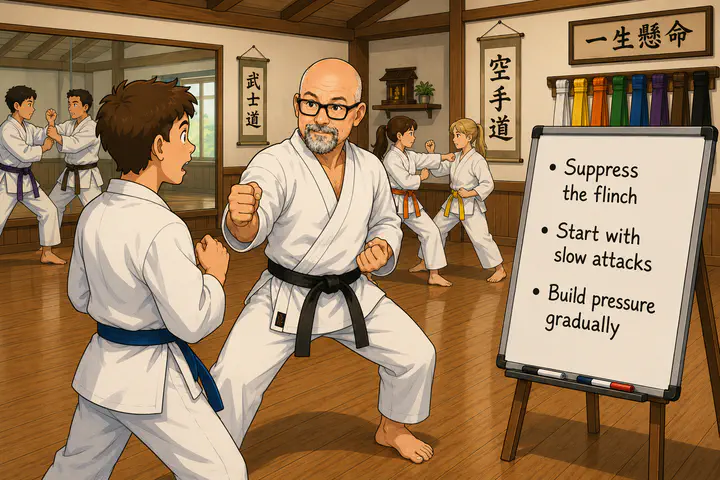
Teaching my regular classes at the Ross Farnsworth - East Valley YMCA.
One of the hardest things to teach in karate is how not to flinch. It’s easy to “punch air”, or perform techniques against a partner who’s not allowed to respond. It’s much harder when the other person is free to respond with techniques of their own. Stances rise, eyes close, breathing stops, and carefully practiced techniques disappear. The student may turn away, retreat, or throw both hands out and hope for the best.
That reaction is the startle response and, while it’s automatic, it can be suppressed through training. A student who repeatedly experiences attacks without being overwhelmed by them gradually starts to treat them as a puzzle to be solved instead of an emergency to be avoided. Breathing continues, eyes stay open, and responses become a choice rather than reflexive avoidance.
Of course, it’s not as easy as saying “don’t flinch.” You have to desensitize students by administering “micro-threats” under controlled conditions until the brain stops treating the stimulus as an emergency. The trick is building right up to the edge of panic, and pushing that edge backwards, without falling over it.
I usually build that pressure a piece at a time:
- Begin with a single, known attack delivered slowly and from a comfortable distance. The student keeps their eyes open and holds their posture without defending. Repeat until any hint of a flinch disappears, then add speed, reduce distance, and repeat.
- Add a simple response, such as moving off the line of attack or touching the incoming attack with the lead hand.
- Give the attacker a choice between two attacks, then gradually introduce additional attacks as the defender becomes comfortable.
Both parties have a responsibility. The defender needs to concentrate on keeping it together while evading, blocking, etc. The attacker has to be able to ramp up slowly and ramp back down when necessary to keep the attacks just shy of the “flinch barrier.”
The goal is not just to recover quickly after panic takes over. It is to prevent the panic reflex from taking control in the first place. Instead of blinking, recoiling, and losing sight of the attack, the student remains present. They see what is happening, keep their posture, and move deliberately. What was once an alarming event becomes a familiar problem, and familiar problems can be solved.