2026-08-17
Teaching my regular classes at the Ross Farnsworth - East Valley YMCA.
I have a new student in my adult class. He’s got experience with a few other fighting styles, boxing included, but none that incorporate kata, so it doesn’t come naturally to him. A punch is familiar enough, but learning a kata means remembering a sequence of unfamiliar stances, turns, blocks, and attacks while everyone else seems to know what comes next. Even a short kata can feel like being dropped into the middle of a dance without knowing the steps.
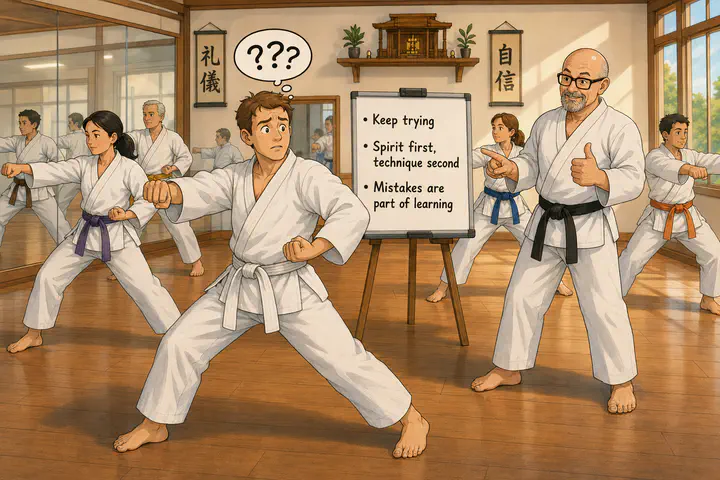
Tonight the rest of the class went through all five Heian katas by the count. I could have sent the new student to the side to practice the first few movements of Taikyoku Shodan, but he has a can-do attitude, so I let him stay on the floor. I told him not to worry about getting everything right and encouraged him to just try to keep up.
It went about as you might expect. He got turned around. He lost his place. Sometimes he copied the person next to him only to discover that everyone had already moved on. By the later katas, he was attempting movements he had never seen before and had no realistic chance of remembering. Still, he never got discouraged or embarrassed. He watched, tried, recovered when he could, and kept powering through.
That is not a small thing. Adults generally dislike being visibly bad at something, especially in front of people who make it look easy. The natural impulse is to step aside, make a joke, or decide that the exercise is pointless because it is too far beyond one’s current ability. He did none of that. He accepted that he was a beginner and kept working.
I wrote almost two years ago about the fifth precept of Funakoshi’s niju kun, Spirit first; technique second. This new student is exemplifying exactly what Funakoshi meant. Good spirit isn’t loudness, aggression, or pretending that a difficult task is easy. It is the willingness to attempt something difficult, fail without taking the failure personally, and try again on the next count.
Technique can be taught. With enough repetition, the stances will become more stable, the turns will point in the right directions, and the sequences will begin to make sense. The attitude that allows a student to endure all those imperfect repetitions is harder to teach. His karate is only beginning to take shape, but he’s already brought the most important thing to class. The rest will come.