2026-08-24
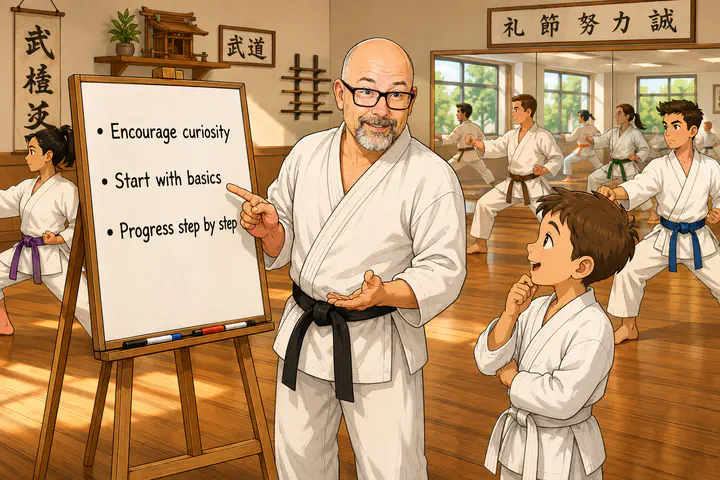
Teaching my regular classes at the Ross Farnsworth - East Valley YMCA.
I wrote about a new student last week and his never-say-die attitude. Over the past couple of classes, he’s also started asking some really good questions.
During kata, he asked if the movements we were doing could be applied to self-defense. This, of course, was a karate instructor’s dream come true, and the rest of the class quickly devolved into basic bunkai drills. Instead of stepping, blocking, and punching imaginary opponents, everyone paired up and learned to how to use the techniques.
Later, during a blocking drill involving a “pre-block” with the off hand, he asked if that pre-block could be used as an attack of its own. The answer was yes. It could strike, seize, clear a limb, disrupt the opponent’s balance, or set up the movement that follows. I almost started improvising a drill to explore those possibilities before thinking better of it.
It can be tempting to chase every interesting application of a technique, especially when a student is curious enough to notice one. That curiosity should be encouraged. It is the beginning of learning to see kata as something more than a sequence of poses. But it is also important to resist the temptation to follow every possibility immediately.
If you’re still learning how to make kiba-dachi, teaching six different applications for the ninth movement of Tekki Shodan is premature. The student has to divide their attention among the stance, posture, direction, hand position, timing, partner, and purpose of the movement. Add too many possible interpretations and none of those things gets enough attention. The interesting material becomes noise.
There is also a difference between understanding that a movement can be used a certain way and being able to use it. I can demonstrate an application against a cooperative partner and make it look convincing, but that says very little about whether a beginner can recognize the opportunity, maintain their balance, control the distance, and perform the movement while somebody is actively trying to stop them. An application is not learned merely because it has been explained.
I likened it to baseball. If you don’t know how to hit, you start with the ball on a tee, then move to “coach pitch,” and then maybe to a pitching machine before finally testing yourself against a pitcher who’s trying to keep you from hitting the ball. Nobody mistakes the tee for a real pitcher, but that doesn’t make tee work useless. It removes enough variables for the student to concentrate on the swing.
Karate is the same way. Start with the most basic of basics with no opponent at all. Learn the shape of the movement and how to organize the body. Then add a compliant partner so the student can feel where the technique makes contact, how distance changes it, and what effect it has on another person’s structure. Gradually allow the partner to become less predictable and more resistant until the student has to recognize and create the opportunity instead of being handed one.
Each stage answers a different question. Solo practice asks, “Can I perform the movement?” Cooperative practice asks, “Can I apply it to another person?” Resistance asks, “Can I make it work when the other person has a vote?” Skipping ahead may feel more realistic, but it often leaves the student struggling with every part of the problem at once.
My new student’s questions are good ones, and I want him to keep asking them. Part of my job is to answer enough to reward the curiosity without burying him under answers he cannot use yet. There will be time to turn the pre-block into a strike, a grab, or something else entirely. First, we need to put the ball on the tee and learn to swing.