2026-08-26
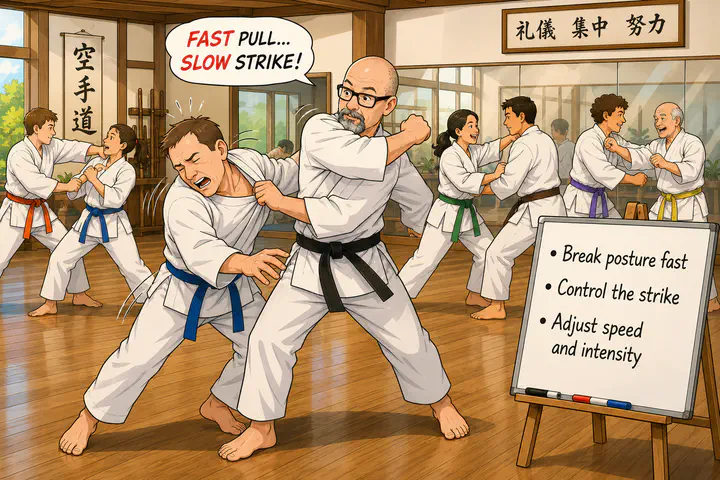
Teaching my regular classes at the Ross Farnsworth - East Valley YMCA.
I got hit in the head - hard.
We were practicing a drill in which one person stepped forward with a punch to the face. The defender blocked the punch, seized the attacker’s arm, and pulled hard enough to break the attacker’s posture and bring their head forward. From there, the defender finished with a yoko-mawashi empi uchi, a roundhouse elbow strike to the head.
At least, that was how the drill was supposed to work.
The students were performing the movements in the correct order, but their pulls were too gentle. The attacker remained upright, which meant the elbow was being delivered against someone who still had their balance and posture, and was out of range. The students were arriving at the correct position, but they were not creating the conditions that made the technique work.
I told them to pull with more speed and intensity.
When that did not produce much of a change, I stepped in as the attacker. I punched, the student blocked, and I invited him to pull me hard enough to break my posture.
He did.
Then he hit me in the head with his elbow.
Hard.
In fairness to him, I had just asked for more speed and intensity. I meant that I wanted more speed and intensity in the pull. I did not expect him to carry them into the elbow strike that followed.
That distinction seemed obvious to me, but I had not made it explicit. I was thinking of the pull and the elbow as two movements with two different purposes. The pull needed to be sudden and forceful enough to compromise my posture. Once that had happened, the student merely needed to place the elbow accurately and under control. He apparently understood the correction as applying to the combination as a whole.
We often talk about practicing a technique slowly or quickly, softly or forcefully. That language makes it sound as though speed and intensity are settings that apply to an entire sequence. Turn up the speed, and every movement becomes faster. Add intensity, and the whole combination becomes harder.
Techniques do not always work that way.
Different parts of a combination perform different jobs. One movement may need to be explosive enough to create a reaction. Another may require steady pressure so the practitioner can feel and control the opponent’s movement. A forceful pull may be necessary to break posture, while the strike that follows must be restrained to protect a training partner. Good practice requires changing speed and intensity from one movement to the next.
Kata often contains examples of this. Movements that suggest seizing, controlling, or locking a joint are sometimes performed slowly. Joint manipulation does not necessarily benefit from being done ballistically, especially when practicing with a partner whose joints we would like to return in working order. The strike that follows, however, may be performed quickly.
The rhythm is slow, then fast: establish control carefully, then strike decisively.
Our drill required almost the opposite rhythm. The pull needed to be fast because a slow pull gave the attacker time to recover, resist, or simply remain upright. The elbow needed to be slow–or at least decelerated before impact–because the attacker’s head had been pulled forward and presented as a target.
The rhythm was fast, then slow: disrupt the posture decisively, then demonstrate the finishing strike safely.
That reversal may have contributed to what happened. The student may have been accustomed to combinations in which a controlled setup is followed by a fast strike. I asked him to make the setup faster and more forceful, but I did not tell him that the strike needed to become slower to compensate. He accelerated the pull and then continued into the elbow at the same intensity.
My head provided immediate feedback about the inadequacy of my instructions. As I write this, the incident was four days ago, and my head is still reminding me.
This is a more difficult kind of control than simply performing everything gently. Anyone can reduce the danger of a drill by moving through the entire sequence slowly and without commitment. That may be appropriate when first learning the movements, but it can also conceal whether the technique actually disrupts the opponent’s structure.
It is also easier to begin slowly and gradually add speed than it is to begin quickly and suddenly take speed away. A student can practice the entire sequence under control, then increase the speed and intensity of the pull while keeping the elbow restrained. Starting with the whole combination at speed asks the student to apply the brakes at exactly the moment when momentum, excitement, and the rhythm of the technique encourage them to continue.
The challenge is to make the important part real without making the dangerous part harmful.
A student must learn to punch with intent and still protect the partner. They must pull hard enough to break posture and then recognize that the resulting vulnerability demands greater restraint. They may need to enter a throw quickly but control the landing, apply a joint lock gradually but strike the opening quickly, or clear a limb explosively before settling into a slower controlling movement.
Speed and power are not switches that remain on for the duration of a combination. They are “dimmer switches” that must be adjusted continuously.
That ability is part of what separates control from mere slowness. Control is not always doing less. Sometimes it means pulling much harder. Sometimes it means moving faster. It means understanding the purpose of each movement and giving that movement the appropriate amount of speed and force - then changing gears when the purpose changes.
Lesson learned: Be careful what you wish for, especially when your head is the target.