2026-09-02
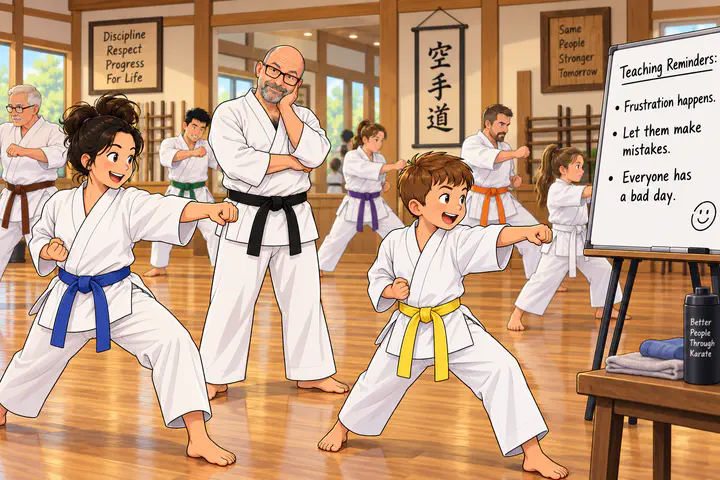
Teaching my regular classes at the Ross Farnsworth - East Valley YMCA.
There are few things more frustrating as an instructor than making the same correction over and over again.
“Make sure your hand comes above your head.”
“Lift your knee above your waist.”
“Don’t land heel-first when you step into back stance.”
I say it. I demonstrate it. I say it again. I make the correction to the entire class so no one is singled out. Then I watch the same mistake happen again, as if I hadn’t said anything at all.
Eventually, I become more direct. Then even more direct. By the time I’ve made the correction painfully obvious, I’m usually on my last nerve.
These aren’t always new students who are still learning how their bodies move. They aren’t students whose physical limitations I haven’t learned yet. They’re often established students whose capabilities I know. I’ve seen them do the technique correctly before. I know they can make the correction. So when they don’t, it can begin to feel intentional.
That’s when the questions start running through my head: Are they ignoring me? If they don’t want to follow directions, why are they here? If they don’t want to learn, why am I spending so much time trying to teach them?
I become tempted to stop correcting them. There are other students in the room — students who listen, make an honest attempt, and clearly want the help. Why not spend my limited time and energy on them?
The answer is that if that student quits, I can’t help them anymore.
That doesn’t make the frustration disappear and recognizing it doesn’t magically replenish my patience or reveal some brilliant new teaching method. By the time I reach the painfully obvious repetition stage, my supply of clever instructional strategies has generally been replaced by an urgent desire to say, “Please, for the love of Funakoshi, put your hand above your head.”
Still, teaching is partly an exercise in persuasion. It isn’t enough to know what students need to do or even to explain it clearly. Somehow, we have to persuade them to actually do it. Sometimes that means finding different words. Sometimes it means demonstrating again. Sometimes it means waiting until a student is ready to hear something we’ve already said twenty times. And sometimes it means letting them figure out the consequence of not doing it that way on their own.
Perhaps this is another part of our own training. Karate is, after all, concerned with influencing other people’s behavior. We’d like to persuade someone attacking us to stop. Better still, we’d like to persuade someone threatening us that attacking in the first place would be a terrible idea.
Convincing a student to lift a knee or change the way a foot lands should be easier than that. Some evenings, it doesn’t feel easier.
I don’t have a tidy solution. I still get frustrated. I still wonder whether my time would be better spent with the students who appear to want what I’m offering. But I also know this experience isn’t unique to me. Every instructor eventually finds themselves repeating a correction to someone who seems determined not to hear it.
When that happens, perhaps we can remember that we’re training too — not just our patience, but our ability to persuade. And, like any other skill in karate, we shouldn’t expect to get it right every time.