2026-09-09
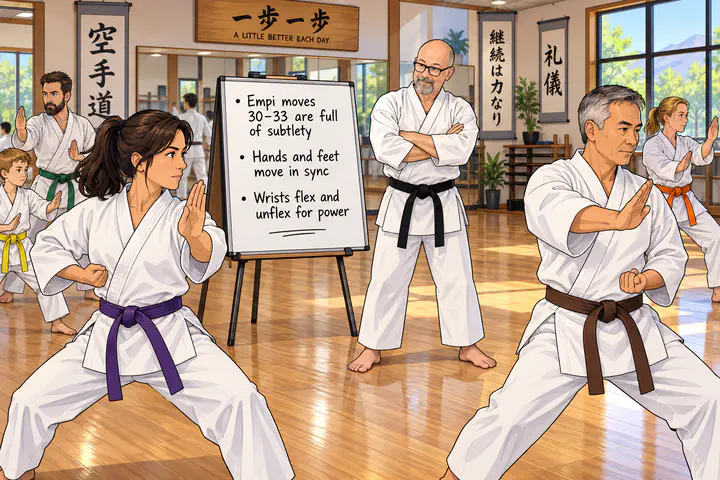
Teaching my regular classes at the Ross Farnsworth - East Valley YMCA.
We spent a lot of time on kata in the adult class tonight, and there were some really good questions about Empi. Moves 30–33 got particular attention. There’s a lot of subtlety in those movements, especially in how the hands and feet work together.
For anyone following along, I’m using the move numbers in this Empi reference.
For move 30, the questions were: How does the right hand move? Is it fast or slow? Is there “kime” at the end?
The left hand draws back to the hip in a fist, in a normal drawing motion. The right hand starts from the hip and opens, fingers splayed to the side, almost like you’re trying to wave to a friend without disconnecting your wrist from your waist. Then the hand rotates clockwise (from your own perspective) and upward to form teisho oshiage-uke. Meanwhile, the hips rotate from hanmi to shomen.
The movement is slow throughout. The right arm finishes in exactly the same position it would occupy for uchi-uke, only with the hand in a rising palm-heel position. There is no hard stop (which some people mistakenly call “kime”) at the end.
Move 31 is easier to explain in two parts. Call them 31a and 31b:
-
For 31a, the left foot comes back very close to, if not together with, the right foot. At the same time, the hands switch positions: the right forms teisho osae-uke, while the left forms teisho oshiage-uke. Everything is synchronized to finish at the same time.
-
For 31b, the right foot steps forward while the hands switch again. The hands are slow and powerful, synchronized with the feet.
The feet come together and apart, as they almost always do when stepping, but the arms do not come together during these blocks. I mention this because sometimes students try to cross their arms during the switch, as they do with the double blocks at the beginning of Heian Sandan. I think of each hand as an elevator in its own shaft, traveling straight up and down. Each hand has its own path and stays in it.
Moves 32 and 33 continue with steps forward, the hands switching places on each step. The same elevator image applies throughout.
There’s another important detail here: the wrists have to change position each time. As the feet come together, the palms rotate so the metacarpals are in line with the forearms. Then, as the stepping foot moves forward into stance, the hands travel up and down, flexing at the wrists into the palm-heel positions as they go.
If you keep the hands in palm-heel position the whole time, you lose that action. You have to “unflex” the wrists so they can flex again. Otherwise, there’s no dynamism to the movement.
These were good questions because they brought us into the details: the path of a hand, the timing of a step, the way a wrist prepares for the next action. There’s plenty to work on in just these four movements.