2026-09-28
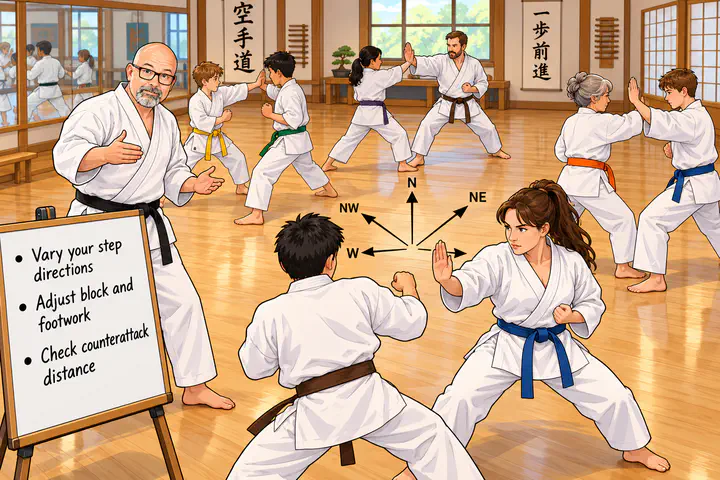
Teaching my regular classes at the Ross Farnsworth - East Valley YMCA.
“Standard” one-step, pre-arranged sparring drills typically have the defender step back and to the “inside” at approximately 45° while blocking, then counterattack. It’s a familiar pattern, and it gives students a consistent place to start. But if we always practice moving in the same direction, it’s easy to get comfortable with that particular arrangement of feet, hands, and distance. An opponent who recognizes that habit can begin to anticipate our response.
I’ve been working on changing that direction by having students move to five different positions. From the attacker’s perspective, assuming the attacker is facing north, I want the defender to end up east, northeast, north, northwest, and west.
That sounds like a small change. Just step somewhere else. But changing where you end up changes quite a bit about how you get there and what you can do once you’ve arrived.
First, the defender has to adjust the footwork and block to suit the direction of movement. The familiar step-and-block at 45° solves a particular problem. Move to a different position relative to the attacker and the relationship between the incoming technique, the blocking arm, and the defender’s body changes. The defender has to work out how to make the block useful from that position while keeping the feet and body ready to continue responding.
Then there’s the counterattack. Changing where you step can also change your distance from the attacker. A counterattack that reaches comfortably after the usual step may no longer fit when you move somewhere else. You may be too far away, or too close. You have to adjust the footwork again, choose a counterattack that fits, or do some combination of the two. You can’t assume that completing the block has conveniently placed you at the right distance to hit back.
This is one of the things I like about the drill. It makes students consider the block and counterattack together. Where will this step leave me? Can I reach from there? If I need to move again, have I put myself in a position that allows it? Those questions can get very little attention when the answer is always the same familiar step at 45°.
Pre-arranged sparring gives us room to work on these details. We can change the direction and examine what that does to the rest of the exchange. There’s plenty to figure out even when both people know what’s coming.
I want students to get comfortable making those adjustments. The familiar angle is useful, but so are the others, and each asks something a little different of the defender. Five places to end up give us five opportunities to examine how the footwork, block, and counterattack fit together. That’s a lot of practice to get out of simply changing where we step.