2026-10-05
Teaching my regular classes at the Ross Farnsworth - East Valley YMCA.
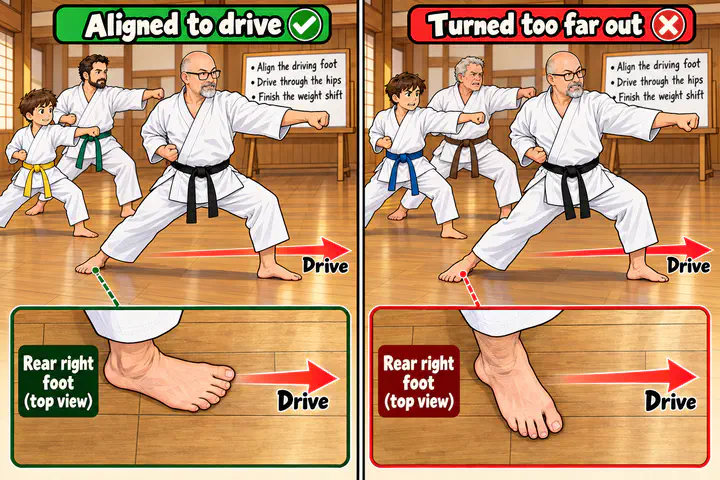
Most students do a good job of making sure their front foot points where it needs to go. The back foot tends to get less attention, even though it’s often the more important of the two. That’s the foot connecting the “drive leg” to the floor, allowing us to generate power by shifting or rotating the hips.
The back foot in kokutsu-dachi is a frequent offender. It gets “lazy” and turns out beyond 90° relative to the direction we’re facing. In kiba-dachi, both feet can get lazy, with the toes turning outward instead of pointing forward. These may look like little errors in the shape of a stance, but they affect our ability to use the legs to drive.
Everyone in my class already knows what this feels like from a reverse-punch drill we’ve done. We start by punching in place with the rear foot pointing as close to straight forward as possible. Then I have everyone turn that foot outward, not just to 90°, which is already too far for this exercise, but beyond 90°, and try again.
Everyone immediately feels the problem. The hip rotation that was available a moment ago suddenly feels impossible to produce from the rear leg. I reminded them of that feeling because the same principle applies when we’re moving between stances in kata. We need the foot positioned so the leg can do its job.
The opening movements of Heian Nidan provide a good example. On the first move, we drop into left-facing back stance, with the hips over the right foot. On the fourth move, we turn 180° into right-facing back stance, with the other leg forward. The heels stay in place while each foot rotates 90°, but the hips have to shift from over the right foot to over the left.
Many students neglect that shift. They leave their hips somewhere between the two feet, fully over neither one. Wrong both times.
I think there are two things going on here. First, they’re anticipating the next movements and keeping their hips too far forward in each stance. They know they’re about to go the other way, so they never quite finish getting to this side before preparing to leave it.
Second, the rear foot is often turned out beyond 90°. That makes driving the hips from that leg feel awkward and weak. The student has less ability to produce the drive, and less inclination to try because it feels weird. Leaving the hips partway toward the next position avoids having to make the full shift. I suspect that, in their minds, it’s easier to have the hips already there than to drive them there from a foot that doesn’t want to cooperate.
My correction was to bring them back to the reverse punch. Remember how it felt when the rear foot was pointing the wrong way? The same problem is here in the back stance. If the drive foot is angled more than 90° away from the direction of drive, we’re making it difficult to use that leg to move the hips. We can keep reminding ourselves to shift, but we also need to give ourselves a foot position that makes the shift work.
I sometimes compare this to a sprinter in starting blocks. Picture the feet pointing in the direction the runner intends to drive. Now picture them pointing off to the side. Nobody would deliberately set up that way and expect a good start, yet we’re quite willing to let a foot wander off in kata and still expect the leg to produce power.
It’s worth paying as much attention to the foot behind us as the one in front. If we’re asking a leg to drive, we need to make sure its connection to the floor allows it to do that.